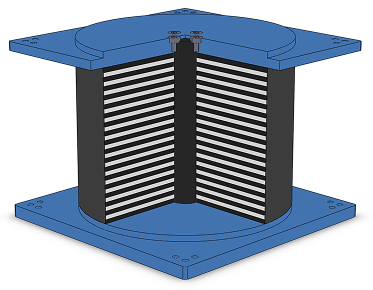
Vibration isolation bearings achieve seismic energy isolation by setting flexible interfaces between building foundations or floors. Its core applications include:
Seismic resistance of building structures
Important public buildings (hospitals, emergency command centers, schools)
Historical buildings and cultural relics protection units
High rise/super high-rise buildings
Precision instrument factory, data center
Bridge Engineering
Support systems for beam bridges, cable-stayed bridges, and suspension bridges
Rail transit elevated bridge
Bridges crossing faults or high-intensity zones
Industrial Equipment and Lifeline Engineering
Main structures of nuclear power plants and thermal power plants
Chemical equipment, large storage tanks
Key nodes of oil and gas pipeline network
special application
Building interlayer isolation
Seismic reinforcement of existing structures
Floating floor foundation vibration isolation
Structural protection achieved through decoupling and energy consumption
The core principle of vibration isolation support is to set a horizontal flexible isolation layer between the upper structure of the building and the foundation. This isolation layer achieves seismic protection by changing the dynamic response of the structure, and its working process mainly includes the following three levels:
Cycle extension and frequency isolation
By utilizing the flexible characteristics of the support, the overall stiffness of the structure is significantly reduced, thereby extending the natural vibration period of the building from a brief 0.3-1.0 seconds to 2.0-4.0 seconds. This change makes the vibration rhythm of buildings much slower than the rapid shaking rhythm with the most concentrated energy in seismic waves, effectively avoiding the main attack range of earthquakes and greatly reducing the energy input to buildings.
Energy redistribution and dissipation
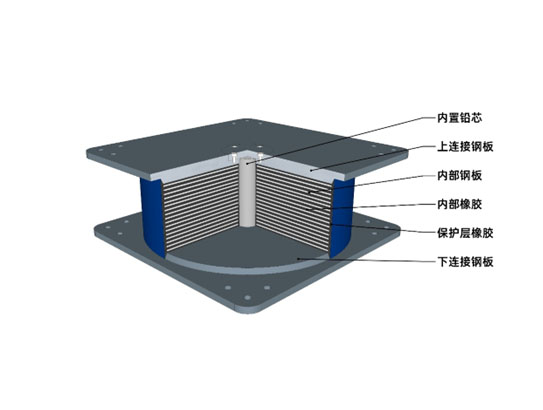
The energy input from the earthquake did not disappear, but was redistributed by the isolation bearings. Part of the high-frequency vibration energy is "reflected" by the flexible layer, while the other part is actively absorbed by the damping mechanism integrated inside the support (such as lead core, viscous material) and converted into thermal energy for consumption. This process is like an efficient 'buffer' that continuously consumes the destructive power of earthquakes.
Displacement control and self resetting
The support allows the building to undergo slow horizontal displacement on the isolation layer, thereby "yielding" to the impact of earthquakes. After an earthquake, the elastic restoring force of the support will guide the building to smoothly return to its initial position.
Contact our team for customized vibration control solutions.